Bringing the Lab to the Patient: Inside David Kinnamon’s Diagnostic Innovations
By Seungjun Lee and Violet Bradshaw
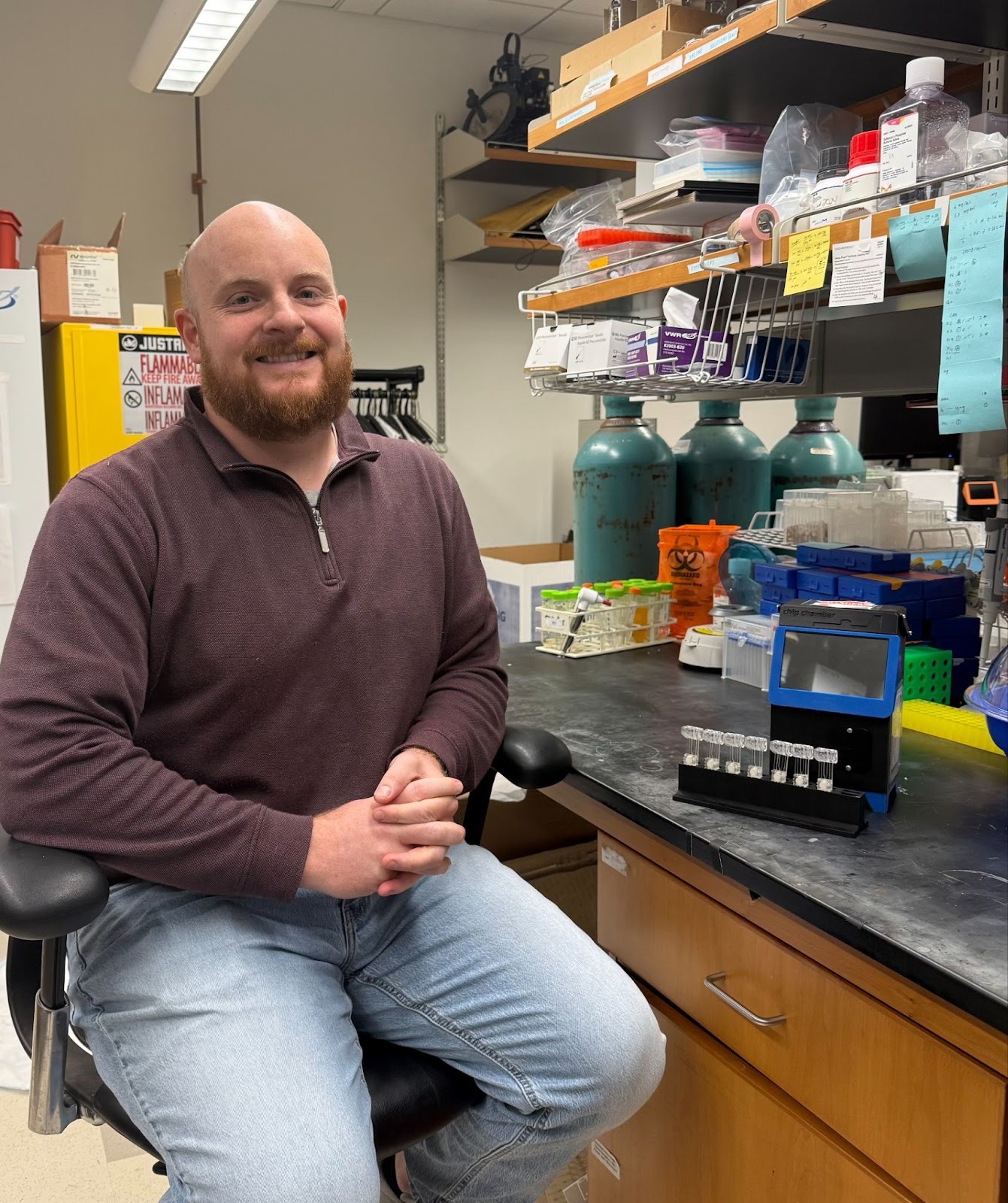
Above: David Kinnamon, Research Scientist at Duke University and CTO of SimplusDX. Photo courtesy of Seungjun Lee and Violet Bradshaw.
“As a kid, I wanted to be a meteorologist,” David Kinnamon mused. “I liked weather, wasn’t really thinking long-term.” While Kinnamon does not currently study atmospheric phenomena, he is a research scientist in Duke’s Department of Biomedical Engineering, working in the lab of Dr. Ashutosh Chilkoti. Instead of forecasting storms, he engineers diagnostic devices to make medical testing faster and more accessible.
His work mainly centers on point-of-care diagnostics. These are compact systems that automate the complicated steps of laboratory testing so that results can be delivered directly to the bedside, for the patient or clinician. Kinnamon explains that creating tools that can reach patients beyond fully equipped labs is one way to reduce the disparities in access to healthcare.
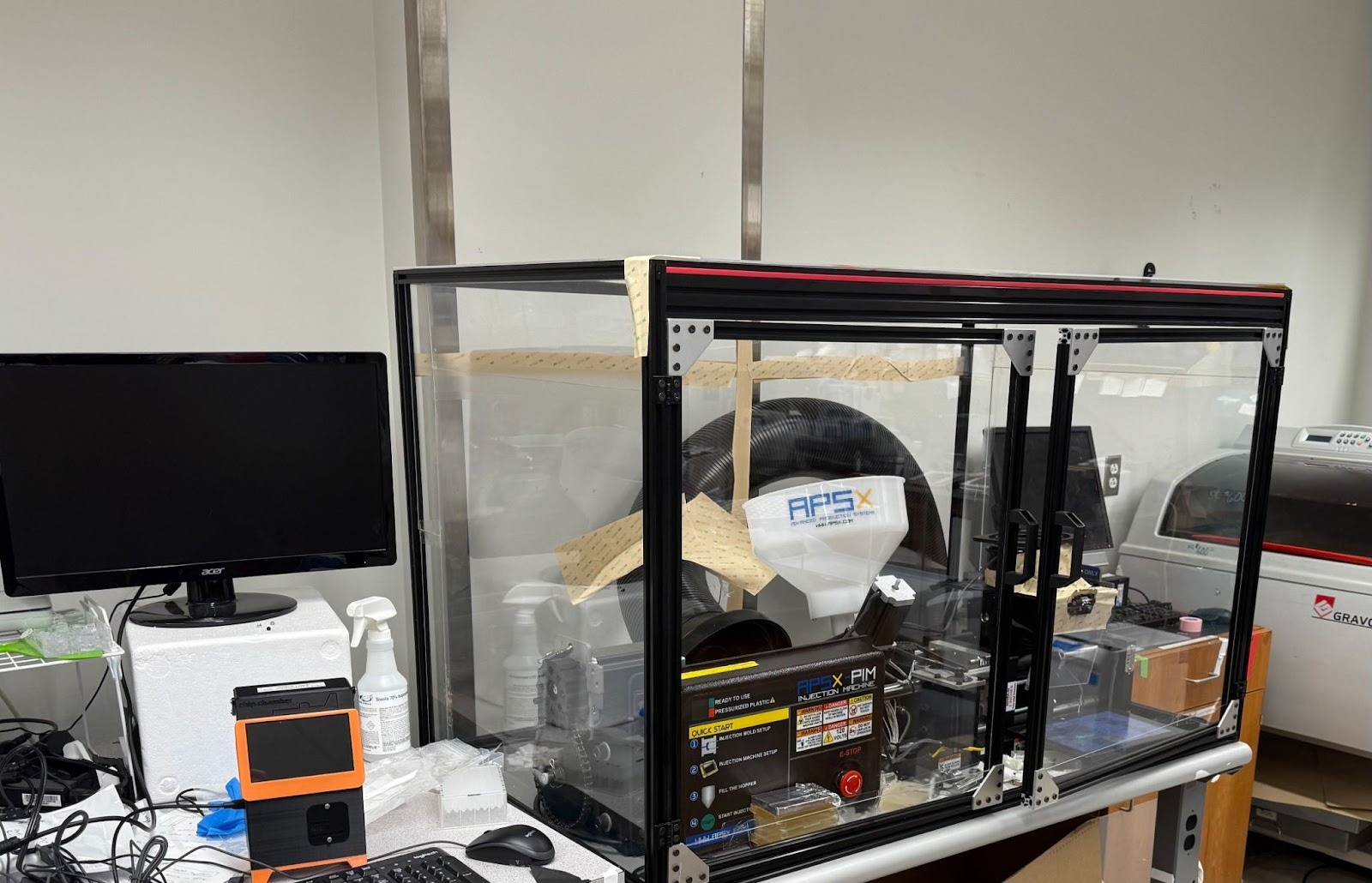
Above: Equipment in the Chilkoti Lab. Photo courtesy of Seungjun Lee and Violet Bradshaw.
Kinnamon’s path into biomedical engineering began at the University of Texas at Dallas. There, he intended to major in mechanical engineering. Early in his freshman year, faculty from a new biomedical engineering program visited his class and described how engineers could design tools for diagnosing and treating disease. Intrigued by the idea of applying engineering principles to healthcare, he switched majors soon afterward. As an undergraduate and master’s student, he worked on wearable diagnostic sensors and found himself drawn to problems at the intersection of engineering and medicine.
After completing his B.S. and M.S. degrees, Kinnamon joined a Dallas startup attempting to translate academic technologies into commercial products. The experience highlighted both the promise and the difficulty of moving early-stage devices into real-world settings. Kinnamon wanted to pursue his graduate studies at a program with strong scientific foundations, access to clinicians, and an environment that supported entrepreneurship. That search led him to the Chilkoti Lab at Duke to pursue his PhD.
Kinnamon’s time in the lab and experience with Dr. Ashutosh Chilkoti have allowed him the freedom to explore ambitious ideas without the pressure to deliver constant positive results. This flexibility has allowed him to take creative risks, learn from setbacks, and develop a more thoughtful approach to problem-solving. He believes this mindset is essential for innovation, especially in fields driven by rapidly evolving technology.
At Duke, Kinnamon focuses on microfluidic systems, small plastic cartridges that automate many of the steps required to run diagnostic tests. These devices contain networks of tiny chambers and channels that move samples and reagents through a sequence of reactions without the need for manual pipetting or timing, allowing the test to be conducted practically anywhere.
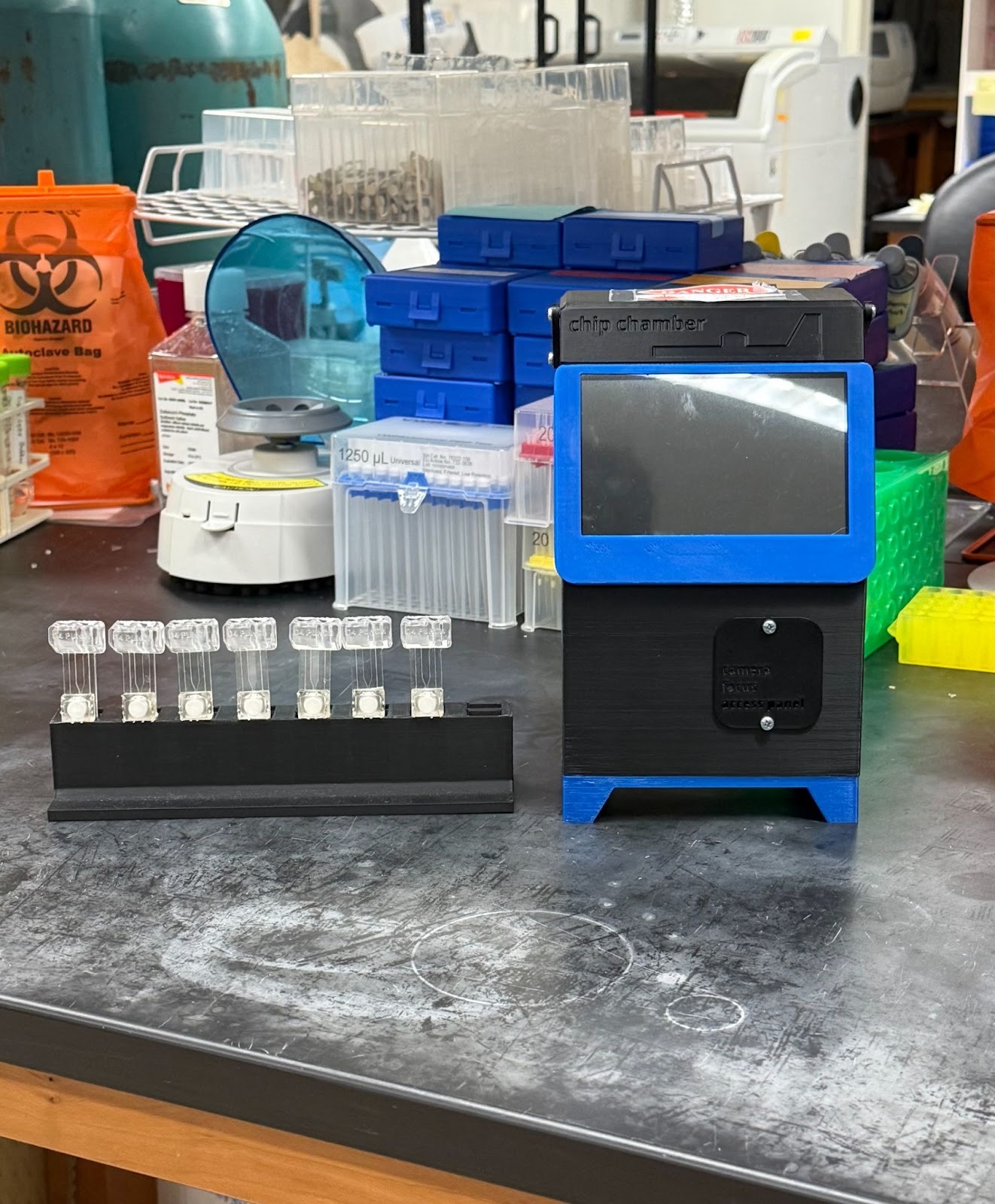
Above: Prototype Microfluidic Cartridge System. Photo courtesy of Seungjun Lee and Violet Bradshaw.
Kinnamon is devoted to opening up doors for cheaper, more accessible diagnoses worldwide. “If everyone had access to the top tier of medical care, everyone would have much better health outcomes,” he said. “But the reality is, not everyone has the same access to the same tests or facilities.” For this reason, the Chilkoti Lab has collaborated with clinical partners in places like Tanzania, Guatemala, and Vietnam on diagnostics for breast cancer, liver cancer, and infectious diseases. These studies involve real patients and samples, grounding the engineering in clinical needs. Working directly with local clinicians helps to reveal logistical barriers that are often overlooked in laboratory environments, strengthening the chances that new technologies will succeed in practice. The Chilkoti Lab’s work with these communities has the potential to help millions of people who are far from hospitals access a diagnosis and therefore quicker and more effective treatment.
Kinnamon’s work extends beyond the academic bubble. In 2024, Kinnamon and several colleagues founded SimplusDX, where he now serves as the Chief Technology Officer. One of the company’s goals is to simplify monitoring of tacrolimus, an immunosuppressive drug taken for life by organ-transplant patients. Patients must undergo frequent testing since even small deviations in drug concentration can have serious consequences. Current methods rely on centralized laboratories and long turnaround times. SimplusDX is developing a faster, more accessible alternative that could eventually allow patients to test from home.
Kinnamon's academic path has led him to a very unexpected field where he has experienced immense success. The best advice Kinnamon could give to young scientists is that students beginning their scientific careers should remember that there is rarely a single correct path forward. “People stress a lot about choosing the ‘right’ school, the ‘right’ lab, the ‘right’ job,” he said. “If you work hard and keep moving in the right direction, things tend to work out – even if they look different than you imagined.” Although David Kinnamon’s scientific curiosity began with the weather, he has found a career that allows for a significant positive impact on the healthcare system and his work will help move the world toward a future where health is more accessible.
Seungjun Lee is a senior at the North Carolina School of Science and Mathematics. Seungjun is interested in connectomics, medicine, and enjoys watching thriller movies.
Violet Bradshaw is a junior at the North Carolina School of Science and Mathematics. Violet is interested in astronomy and chemistry, and loves to watch and play basketball.