For a child, the emergency department is a place where fear lives. The loud sound of monitors beeping, the smell of medicine, and the threat of needles have many children quaking with fear. Usually, doctors and other medical professionals handle this copious anxiety by reaching for the medical cabinet for drugs to soothe the child’s nerves. But while these drugs work, most of the time, the young patients wake up disoriented or angry.
A study published in March of 2025 in JAMA Network Open suggests that the most effective ‘technology’ for calming a child might not be just a drug, but a bond with man’s best friend. Researchers at Indiana University and the Human Animal Bond Research Institute (HABRI) discovered that just ten minutes with a therapy dog can significantly change a child’s emotional response to a white medical room.
The Biological Mechanism: Cortisol and Oxytocin
The research team at Indiana University didn’t simply observe how cute a dog could be or how a child relaxes when petting a safe animal. The team focused on a specific hormone called salivary cortisol. Cortisol is technically the body’s primary “stress alarm.” When you see something that scares you, cortisol levels spike, causing your heart rate to increase. By collecting about 80 saliva samples from pediatric patients, the team could measure the “fight or flight” instinct that is wired into all of us.
The study was randomized, where one group of pediatric patients ranging from 5 to 17 years old received normal care, whereas another group interacted with a certified therapy dog ten minutes before receiving the normal care. The results were incredible: children in the group allowed to play with the dogs had a 46% reduction in anxiety and an incredible drop in their cortisol levels.
This shift is caused by a process called oxytocin synchronization. When humans interact with calm animals, the brain releases oxytocin, which is often called the “cuddle hormone.” Oxytocin acts like a natural brake system for the fear system in the brain. However, this biological “loop” doesn’t just benefit the child; researchers for animals have found that therapy dogs also benefit from this as well!
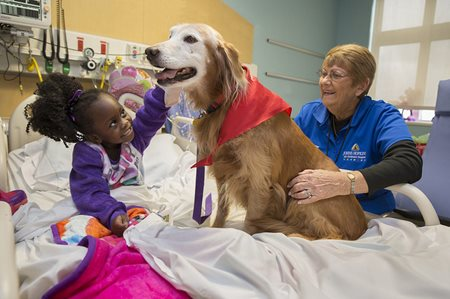
Above: A picture of a real-life therapy dog helping a child. Image courtesy of John Hopkins Medicine.
The Big Picture
This research is a game-changer for anyone interested in medicine. For pediatrics, it proves that animal intervention is a real clinical tool, not just a distraction for when the kids need to get a shot. It means we can reduce the scariness of going to the doctor. For veterinary science, it shows that dogs are not just pets that we take care of – they are essential healthcare partners. Healing doesn’t just happen in a lab or in a white room. Healing happens with a bond between species. And sometimes, the most advanced medical tool we have is a wagging tail.
Written by Saasana Karthikeyan, this article was selected as a winner of our 2026 High School Science Communication Challenge. From Raleigh, NC, Karthikeyan is a student at Enloe Magnet High School.