Imagine if the algorithm that picks your next song recommendation could remix chemical recipes to whip up chemicals that fight bacteria. New research published in Nature Microbiology reveals how AI algorithms, trained like pattern-spotters, design custom antimicrobial peptides that disrupt bacterial processes to battle antibiotic resistant bacteria.
When bacteria face antibiotics or other treatments, they learn from the attack. Their defense systems store "memories” of the drug. This setup primes faster counter-responses upon reinvasion. This helps bacteria develop resistance against therapeutics they are persistently exposed to, and this resistance can also be transmitted, increasing deadliness.
The development of resistance makes it difficult to target bacteria, but there are ways to stop or limit this. Antimicrobial peptides (AMPs) are short proteins from living hosts. They interfere with bacterial cellular processes to limit resistance. For example, AMPs permeabilize bacterial cell membranes, form pores that cause rapid cell bursting, and disrupt intracellular targets like DNA/RNA synthesis and protein folding, both integral to bacterial survival. While conventional antibiotics act on a small number of fixed intracellular targets and therefore select resistance relatively quickly, antimicrobial peptides are more promising from a resistance standpoint because they employ diverse modes of action.
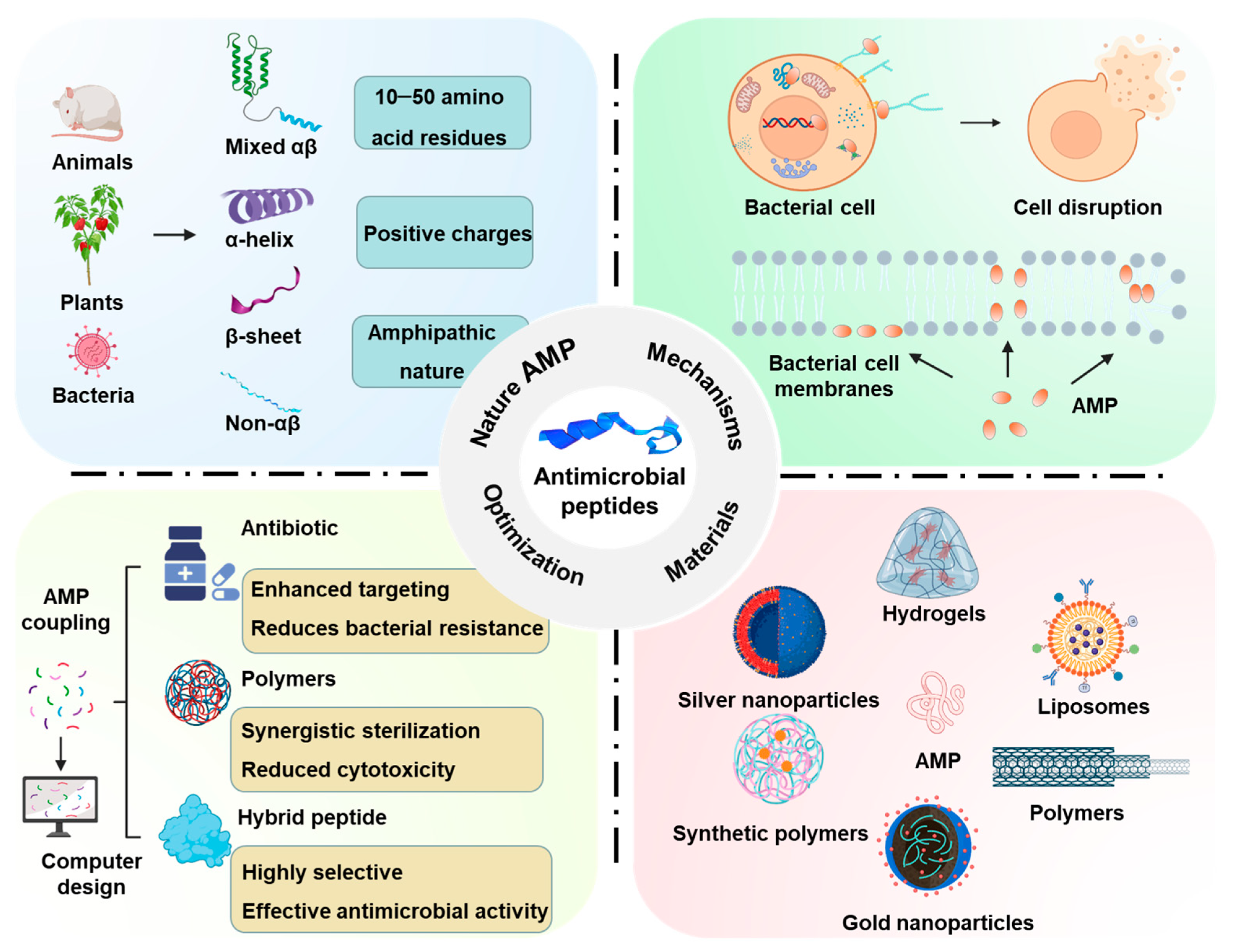
Above: Classification, sources, structures, mechanisms, and applications of antimicrobial peptides.
Image courtesy of Zhang et al.
The multi-target mechanisms of AMPs make it difficult for bacteria to develop resistance against them. Multiple mechanisms mean that it is less likely for a mutation to confer resistance.
Large language models (LLMs) train on vast datasets to identify patterns. It’s like scanning all the songs you listened to in the past month to find the genres and artists you’re most likely to enjoy: the ideal songs for you. AMPGenix builds on ProteoGPT, a protein LLM pre-trained on 609,216 protein sequences, learning chemical properties like net charge and hydrophobicity. These chemical properties are like the specific genres or sounds that a music algorithm looks for when it predicts your next favorite track.

Above: AMPGenix AI pipeline overview: from data training to peptide generation and testing.
Image courtesy of Wang et al.
Transfer learning is the process of taking a model that understands general patterns and then training it again on a more focused dataset so it becomes better at a specific task. ProteoGPT was trained on 609k proteins and later fine-tuned on additional AMP datasets for AMPGenix. For example, if your music listening app identified general listening patterns and then fine-tuned on your rock listens, it now predicts rock band variations like a pro. After transfer learning, the authors report "the creation of the stable AMPGenix model with minimized loss," generating 76% AMP-positive sequences vs baselines.
The algorithm was then used to generate novel peptide sequences by recombining optimal patterns, such as cationic, amphipathic profiles that are ideal for disrupting bacterial membranes.To test these AI-designed peptides, scientists first used lab experiments to assess how well they could kill multidrug-resistant CRAB and MRSA, which are highly fatal due to their resistance. In these assays on top candidates, "both the mined and generated AMPs demonstrated comparable or superior antimicrobial efficacy to clinical antibiotics." Follow-up tests in mouse infection models showed that these peptides worked in living systems while remaining low in toxicity, providing anti-inflammatory benefits and slowing resistance emergence.
As the model captures a wider range of antibacterial and structural properties, AMPGenix-generated AMPs showed significantly higher predicted antimicrobial activity than mined AMPs. Notably, "the model could capture a wider range of antibacterial properties and structural features, thus better generating peptides with superior antibacterial effects."
AMR poses a precipitously escalating global health crisis, projected to become the leading cause of death by 2050. AMPGenix accelerates discovery of safe, potent antimicrobial peptides (AMPs) to combat deadly multidrug-resistant superbugs like CRAB and MRSA. Unexpectedly, the same LLMs powering your next song recommendation are now engineering weapons to eradicate these fatal organisms.
Written by Tara Pratapa, this article was selected as a winner of our 2026 High School Science Communication Challenge. From India, Pratapa is a student at Indus International School Hyderabad.