A team of German scientists has developed a nutritious, tasty vegan protein by repurposing leftover carrot byproducts from produce manufacturing.

Above: Carrot hot dogs. Image courtesy of Sweet Simple Vegan.
The global population is projected to reach 9.8 billion by 2050. Meeting the nutritional needs of a growing population, particularly amid escalating humanitarian crises, will require more sustainable and efficient food production systems. The meat industry supplies food for billions of people worldwide, but carries serious environmental consequences. Livestock production alone accounts for 14-18% of greenhouse gas emissions and 32% of methane emissions. Furthermore, while two-thirds of agricultural land is utilized to grow livestock, only about 8% is used to cultivate food for direct human consumption.
As a result, in recent years, advocates have promoted plant-based meat alternatives as one strategy to reduce the environmental impact of food consumption, as these protein sources generally require less land and water and generate fewer greenhouse gas emissions than animal products. Researchers and food companies alike have turned to fungi as a promising foundation for next-generation protein sources.
Producers can cultivate fungi either as the visible mushroom bodies or as mycelium, the dense, root-like network that forms the main body of the organism. Mycelium is particularly attractive for food production because it grows rapidly, requires relatively little space, and naturally develops a fibrous, meat-like texture. In late 2025, a group of German scientists demonstrated a novel way to exploit these properties by combining fungal mycelium with carrot-processing byproducts to create a vegan meat alternative.
The researchers began by collecting liquid side streams (byproducts like pulp and juice) generated during the production of natural food colorants from orange and black carrots — materials that are edible but typically discarded. These carrot side streams were first incorporated into agar-based media, which were used to screen a wide range of fungi for their ability to grow on carrot-derived nutrients. In this initial screen, 106 edible fungal strains were evaluated for growth performance, protein content, and basic sensory features like smell. From this screen, researchers selected a smaller group of high-performing strains for further study.
The team then grew the selected candidates in submerged liquid cultures, in which they cultivated the fungi directly in carrot-based liquid media without agar. This method allowed researchers to better assess biomass production and protein yield under conditions more representative of industrial fermentation-based food production. Through additional optimization of factors such as carbohydrate concentration and pH, the researchers narrowed the candidates further, ultimately identifying Pleurotus djamor as the most promising strain.
Pleurotus djamor mycelium stood out for several reasons: it grew efficiently on both carrot side streams, exhibited a neutral aroma well suited for food applications, and belongs to a fungal genus that food producers already use. Because the researchers intended to use the mycelium as a food ingredient, evaluating its nutritional value was a critical part of the study. Analysis showed that the mycelium qualified as high in protein, with crude protein accounting for more than 20% of its total caloric value – an important feature for a satisfying and nutritionally meaningful meat substitute. The researchers also assessed the biological value of the protein, a measure of how efficiently the body can use dietary protein, which is a critical property for protein alternatives. Notably, mycelium grown on black carrot medium exhibited a biological value comparable to that of animal-derived proteins, while mycelium grown on orange carrot medium showed values similar to common plant proteins such as soy. In addition to its protein content, the mycelium contained high levels of fiber, including chitin and α- and β-glucans, while remaining low in fat.
While the lab results showed promise, to evaluate real-world applicability, the researchers incorporated the mycelium into vegan meat substitutes. They prepared meat patties and sausages, first using 100% soy protein then progressively substituting fungal biomass until the products were made entirely from mycelium. In sensory tests, participants consistently rated patties made entirely from mycelium as more appealing in texture, flavor, and overall satisfaction than those made solely from soy protein. These findings suggest that mycelium grown on carrot side streams is not only nutritious, but also competitive in taste with existing plant-based protein sources.
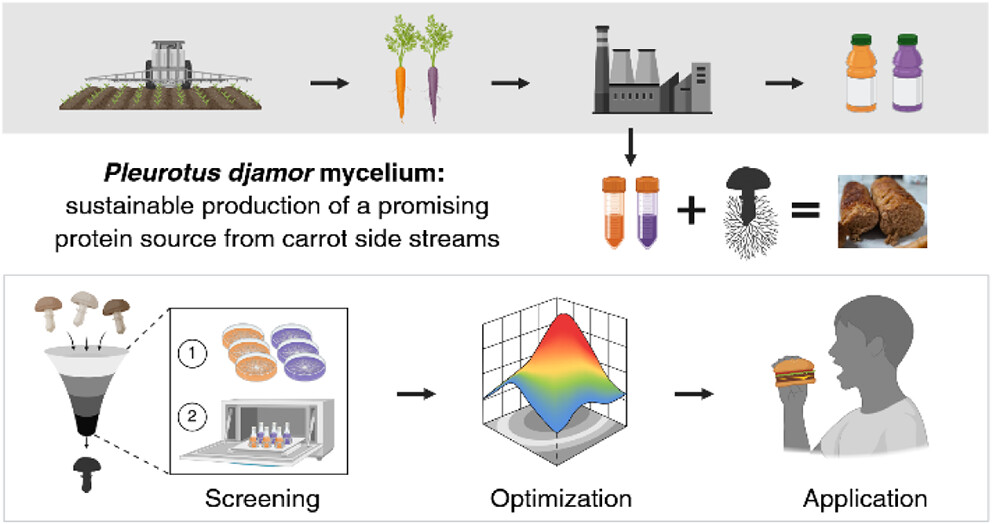
Above: Graphical abstract showing steps researchers took to engineer carrot-derived plant-based meat. Image courtesy of Juhrich et al., 2025.
While this particular study has not yet advanced beyond the lab, consumers can already access other mycelium-based foods. Products made with mycelium, such as those produced by the food company Meati, demonstrate that fungal proteins work outside the lab in everyday meals. While Meati grows mycelium through fermentation rather than agricultural side streams, both approaches rely on the same biological material and highlight its versatility. The positive consumer response to these products support the findings of the carrot mycelium study, suggesting that mycelium-based alternatives may help bridge the gap between plant-based nutrition and the taste and texture that consumers enjoy from meat.
