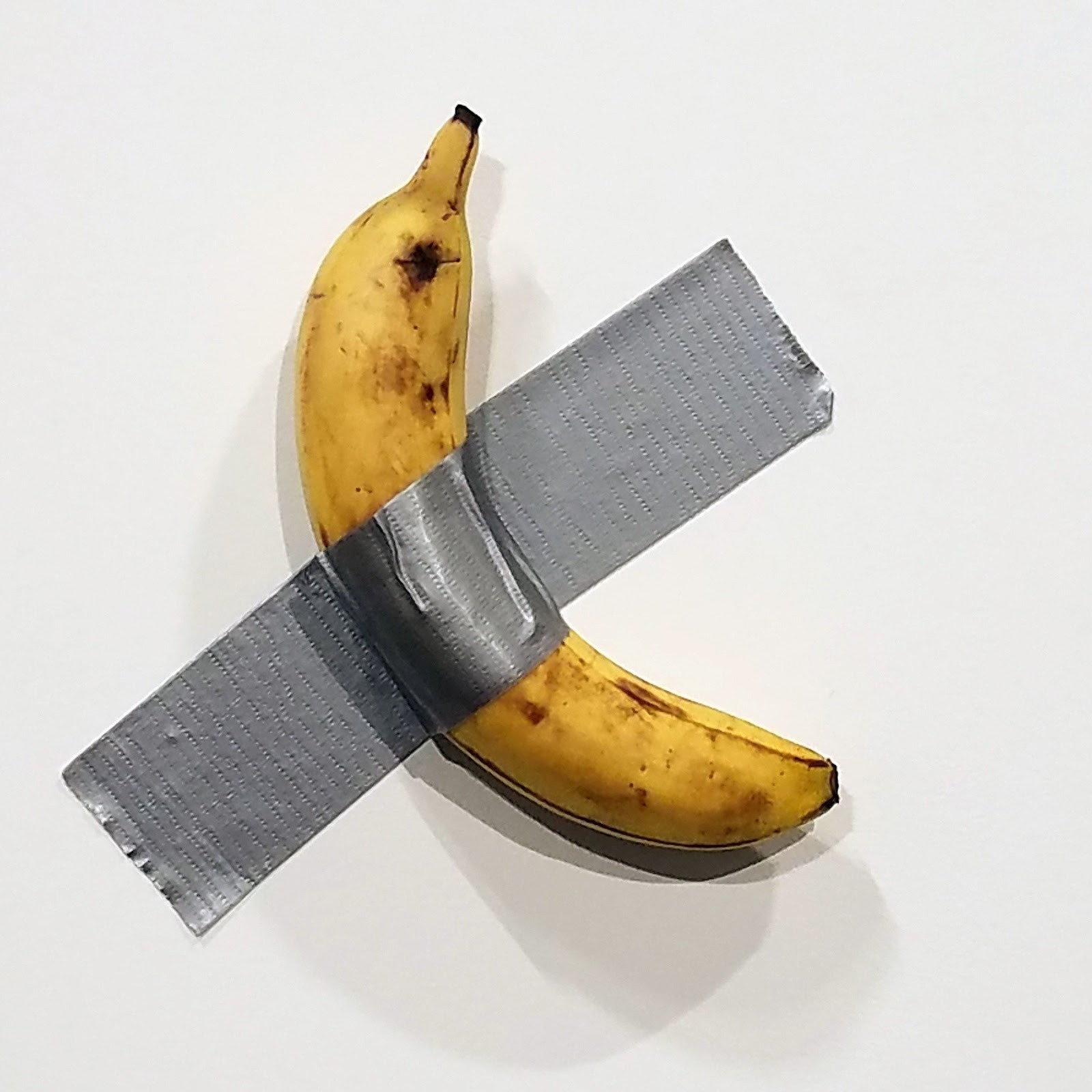
Above: Maurizio Cattelan’s controversial contemporary installation titled Comedian. Image courtesy of Vogue.
Startled awake by a rather exasperating alarm, I realized I was running late to a very important morning meeting. Attempting to assemble a breakfast from expired yogurt, Chinese takeout, and half-empty energy drinks, I settled for the decaying banana hiding in the back of my fridge. In my half-awake fury, I managed to eat a $6.2 million breakfast. Maurizio Cattelan, the famous contemporary Italian artist and creator of Comedian, on the other hand, was not so quick to waste his morning snack.
In late 2024, it was hard to go on the internet without seeing the public outrage at Cattelan’s duct-taped banana after being sold at Sotheby’s for an egregious $6.2 million. I’m certainly upset I didn’t reach for the duct tape before heading to my fridge this morning. Contrary to many comments about the installation, this piece by no means reflected a shift in the paradigm of contemporary art. Artists like Marcel Duchamp, one of the most famous Dada artists, explored comical conceptualism through a sculpture of a urinal. Yves Klein painted canvases solid blue, while Mark Rothko overlaid horizontal blocks of color, yet both artists are forever cemented in history for their enduring impact. Contemporary art explores many of these same motifs and styles. That being said, it is not within the purview of this article to answer the question “Is contemporary art good?” I’d rather not bite off more than I can chew, especially after I’ve just had breakfast.
Instead, this piece examines contemporary art from a more scientific perspective: neuroaesthetics. Neuroaesthetics is an emerging discipline within neuroscience that explores the biological bases for our sensory appreciation of the world around us through aesthetic experiences. An aesthetic appreciation for the world around us is critical to the human experience and an integral feature that differentiates us from other species. Importantly, it can be explored empirically through neuroscience. Neuroaesthetics has shown that aesthetic appreciation for visual art presents a high degree of symmetry across cultures. So, might it also provide some insight into why contemporary art’s reception presents such a dichotomy; put more simply, why do some see a breathtaking commentary on the nature of value and consumerism, while others see compost scraps taped to a wall?

Above: Jean-Honoré’s famous late Rococo piece The Swing. Image courtesy of Artsy.
Beauty and the Brain: Why “Pretty” Feels Good
Looking up at a breathtaking composition of cohesive colors, geometries, dynamics, and human proportions, there’s a near-universal feeling of awe and appreciation that consumes us. Through numerous meta-analyses based on fMRI studies, conventionally “beautiful” art, like that from the Renaissance, Rococo, Baroque, or Impressionist movements, has been correlated with three major frontal areas of the brain: the ventromedial prefrontal cortex (vmPFC), the inferior frontal gyrus (IFG), and the frontal pole (FP).
The vmPFC performs a critical process known as subjective evaluation, essentially evaluating how much your brain likes the stimulus it’s receiving. The vmPFC also integrates a substantial amount of information from the visual cortex to determine whether it will send signals of enjoyment to the rest of the brain. The vmPFC simultaneously receives information regarding the color relations and the dynamics (movement) within the piece. Both of these inputs lead to decisive responses in the vmPFC as to whether the colors are predictable (e.g., a beautiful sunset) and the motion is captivating (e.g., two people holding each other tenderly). The IFG has been implicated in the semantic processing of these “beautiful” art pieces, like comprehending language, understanding symbols, and emotional mirroring/empathy.
In the brain, after the stimulus passes through the vmPFC and IFG, the appreciation of art expands beyond the visual to the interpretational. The FP takes this a step further as it's responsible for the reflective thought, self-referential processing (i.e., “What does this mean to me?”), and abstract reasoning. Have you ever caught yourself staring at a particular art piece that “just moves you?” Modern neuroaesthetics would argue that it’s actually your FP being activated.
For most contemporary art appreciators, the description of “being moved” presents itself as a cornerstone of their experience. This begs the question: Is it in that earlier integration of visual information to the vmPFC (the bottom-up processes) that the universal beauty begins to falter? Or rather, is it in the symbolic understanding through the IFG and the higher-level reflection via the FP (the top-down processes)? Perhaps there is something more fundamental in how simplicity becomes appreciated.
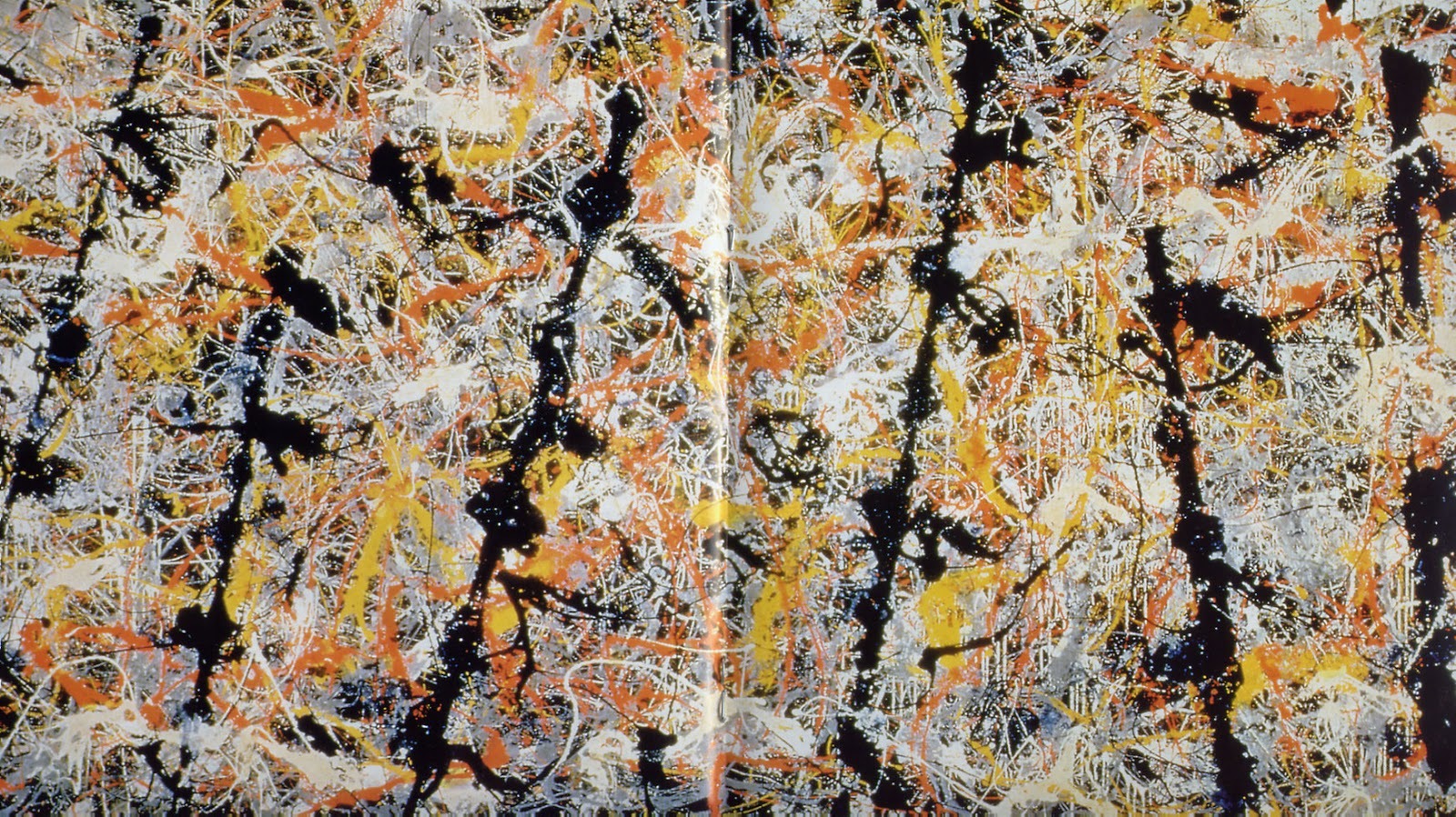
Above: Jackson Pollock’s famous abstract expressionist piece Blue Poles. Image courtesy of Singulart.
More Than Meets the Eye: When Art Demands Thought
It is worth clarifying a common misconception on the difference between modern and contemporary art upfront. Modern art refers to pieces created from roughly the 1860s to the 1970s. Any piece created after that then falls into the category of contemporary art. Modern art encompasses pieces that share the abstractionism and minimalism of contemporary art (see much of Jackson Pollock’s oeuvre). However, other famous modern works, such as Vincent van Gogh’s The Starry Night and Salvador Dali’s The Persistence of Memory, are venerated for their complexity.
Using our banana piece (Comedian) from the introduction as an example, there’s reduced activation shown in the vmPFC relative to conventionally “beautiful” art. Your visual cortex is not able to easily focus on recognizable figures, pleasing patterns/colors, and predictable shapes. Thus, it does not produce the same immediate dopamine release that would come from viewing an ornate, dramatic, and highly realistic Baroque piece. Moreover, another region of the brain, known as the dorsal anterior cingulate cortex (dACC), responsible for conflict monitoring and error detection, has been shown to exhibit increased activity in response to contemporary art. This region of your brain processes this contemporary art against expectations of what art “should look like” (i.e., the conventionally “beautiful” art), leading to great discomfort, displeasure, and initial confusion with these pieces.
However, contemporary art also demands relatively enhanced activity of prefrontal cortex regions, such as the FP, in inferring meaning, interpreting the symbolism, and self-reflection on these fairly abstract works. This higher-level processing helps reevaluate one’s initial response by signaling to the vmPFC that this art now “has value” or is “beautiful in an interpretive manner.” Hence, much of the pleasure derived from conceptual artwork, at least as neuroaesthetics would suggest, derives from cognitive engagement, discovering meaning, contextual understanding, and insightful reflection.

Above: Silhouetted woman with various geometric, planetary shapes and colors surrounding her. Image courtesy of Johns Hopkins Medicine.
From Initial Pleasure to Long-lasting Insight: Rethinking Aesthetic Reward
While contemporary art doesn’t provide that initial dopamine rush and vmPFC activity we see elicited by conventionally “beautiful” artworks, it can certainly contribute to a subjectively meaningful aesthetic experience after taking a moment to sit with the work, analyze it, and reflect upon it. Concisely, the rewards of contemporary art appear to be found more in top-down processes. Still, it is unreasonable to expect every passerby to visit their local gallery prepared for a deep cognitive analysis of deconstructed metaphors and hidden meanings. For many, it’s as simple as wanting to see aesthetically pleasing pieces by talented artists. Unfortunately, contemporary art tends to fall short for these bottom-up reward seekers.
The question then shifts to the viewer: Do you want art that meets the eye or the mind? In most cases, it is both. Contemporary art is not a cultural affliction to be endured. Its themes are not some unfamiliar entity; we’ve seen abstractions, convoluted metaphors, and complex contexts in artwork throughout history. For the readers who feel neglected by the surplus of conceptual artwork in the contemporary era, I urge you to explore contemporary artists like Roberto Ferri and Jeremy Lipkin, whose technical brilliance and verisimilitude will dazzle even the most resolute of critics.
Art has, and forever will be, a pulse-check on humanity; it’s a tangible expression of how the artist sees some facet of our world. Art is not meant for consumption; it offers a fleeting moment for our human experiences to coalesce into something physical. If neuroaesthetics has taught us one thing, it’s that our brains are primed to find beauty in the world. There is something deeply biological that forces us to appreciate life. So, if you ever see another banana on the wall at an art museum, sit with that discomfort to see if it transforms into insight. If it doesn’t, then simply keep walking; that art does not have to be for you. It can simply be a frantic undergraduate's breakfast.
