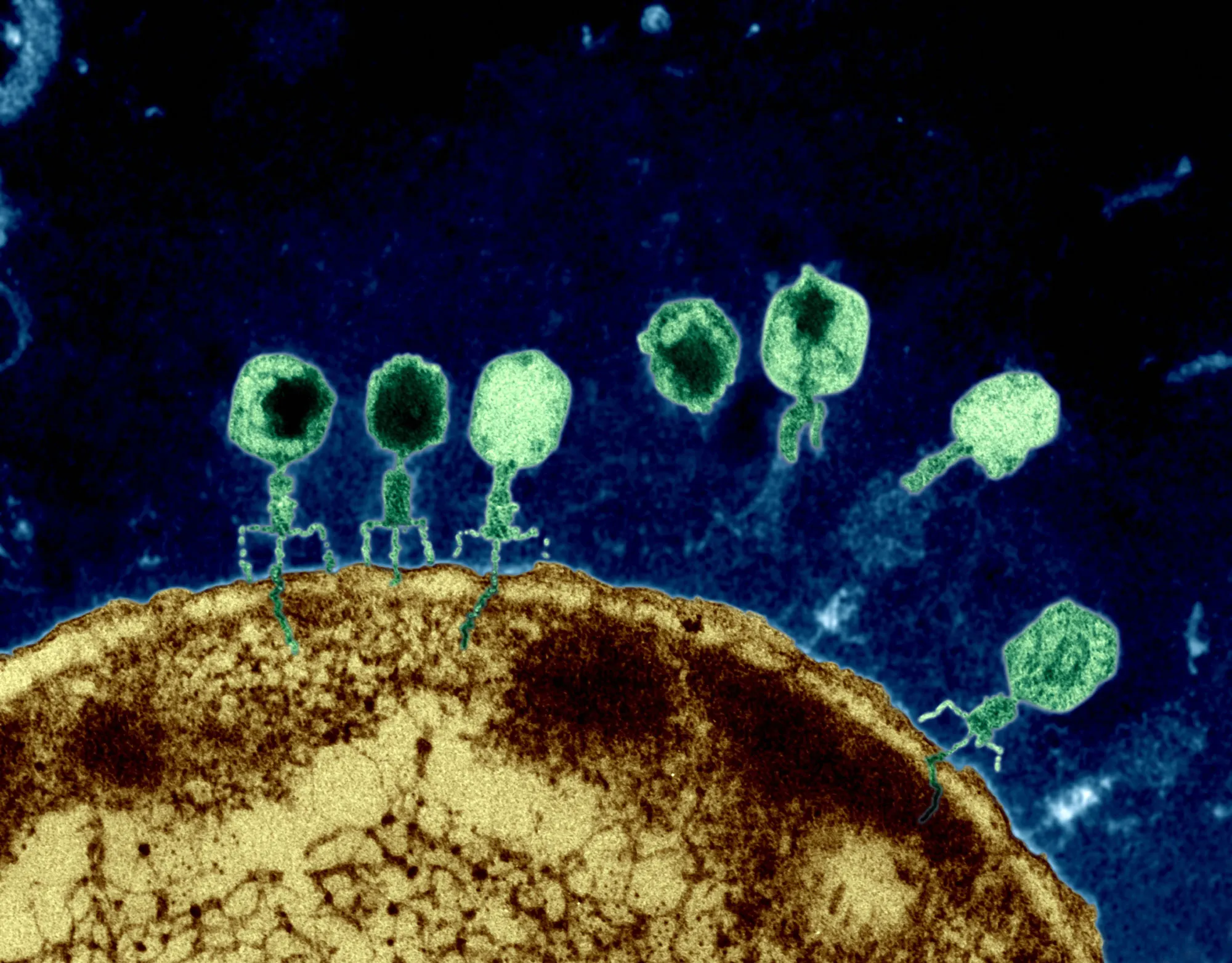
Above: Bacteriophages attacking an E. coli cell. Image courtesy of The New Yorker.
In 1976, biologists sequenced the first complete genome of a bacteriophage, a virus often considered too simple to even be classified as a living organism. Now, just fifty years later, scientists are beginning to design entire genomes, once again starting with that of the humble bacteriophage.
Genomics: The Beginnings
Before Frederick Sanger developed Sanger sequencing, a DNA sequencing technique that would be awarded the Nobel Prize in Chemistry in 1980, the exact nucleotide sequence of any organism’s genome was a complete mystery. Direct comparisons between genomes, identification of specific mutations associated with genetic diseases, and understanding evolutionary relationships at the molecular level were all impossible. The development of genome sequencing techniques opened the door for genomic research to truly take off, allowing researchers to connect single nucleotide mutations to phenotypic changes, understand the genome makeup, and precisely trace the evolutionary linkages between species.
The development of DNA sequencing techniques also initiated efforts to sequence the genomes of all known organisms, starting with the simplest. With a length of just over 5,000 nucleotides, the genome of the φX174 bacteriophage was completed first. Bacteriophages (or phages) are viruses which infect and kill bacteria, and φX174 is a single-stranded DNA phage which specifically infects E. coli.
In the years that followed, scientists began tackling the task of sequencing increasingly larger genomes. However, despite breakthroughs such as Sanger sequencing, these methods remained slow, typically sequencing only a few hundred nucleotides at a time and requiring computers to perform the monumental task of assembling complete genomes from these short reads. In 1995, all 1.8 million base pairs of the bacterium Haemophilus influenzae were reported, representing the first complete genomic sequence of a living organism. A year later, the yeast genome was sequenced, marking the first eukaryotic genome.
Concurrently, a major international effort was underway to sequence the human genome. The Human Genome Project (HGP) began in 1990 with the goal of sequencing the entire human genome over 15 years, at an estimated cost of $3 billion. The task of using Sanger sequencing to determine all three billion base pairs of the human genome, a few hundred nucleotides at a time, was divided between twenty universities across multiple countries. Ultimately, the HGP concluded in 2003, producing the most complete map of the human genome possible at the time. However, it was not until 2022 that the human genome was finally completely sequenced, reporting every base pair on every chromosome.
A New Era
Since Sanger first developed the methods for genome sequencing, genetic research and genetic techniques have advanced at a breakneck speed. Techniques such as CRISPR-Cas9 have allowed scientists to precisely edit specific locations in the genome, opening the possibility that previously incurable genetic diseases could one day be cured. However, in 2025, researchers went a step even beyond genome editing, using artificial intelligence (AI) to generate a complete bacteriophage genome.
Excitement in recent years over the powerful applications of AI has driven the development of models tailored for specific fields, with the fields of biological and medical research being no exception. Large language models (LLMs) such as AlphaFold and ProGen have been fine-tuned to predict the three-dimensional structure of biomolecules from genomic sequences and to generate new proteins, respectively. However, generating complete genomes presents a considerably greater challenge than creating a single new protein. Beyond simply constructing new protein-coding sequences, the model must also consider the interactions between these genes and their regulatory elements. Additional concerns include gene order and, for eukaryotic genomes, splicing patterns, among many other complications.
In a not-yet peer-reviewed article, researchers from Stanford University used Evo, a genomic language model trained on millions of genomes and capable of generating new DNA sequences, to engineer novel bacteriophage genomes. After providing the AI model with a fragment of the φX174 genome, Evo was able to “autocomplete” the sequence, producing hundreds of new φX174-like genomes. Most impressively, when the researchers used these generated sequences to build actual bacteriophages, the AI-designed phages not only successfully targeted and infected E. coli but were also able to kill bacterial strains that had evolved resistance to the wild-type φX174 phage.
Applications and Limitations
The ability to create whole genomes opens a world of possible applications. Antibiotic-resistant strains of bacteria could be targeted with engineered phages, and safer, more effective delivery vectors could be created for gene therapy. However, as with all new biotechnology tools, there is potential for misuse and harm. One could imagine that tools such as Evo could be used to create viruses capable of infecting humans and causing disease. When training Evo, the authors of the paper specifically excluded viruses that infect eukaryotes and deliberately selected the φX174 bacteriophage and E. coli strains as model organisms due to their low risk to eukaryotes. The authors further note that careful consideration of the applications of tools such as Evo are necessary before it can be fully utilized by the biomedical community. Still, the ability to create new genomes represents a massive step forward in the biomedical field, realizing what was perhaps only a distant possibility less than 25 years ago, when the human genome was just being pieced together.