Where Curiosity Meets Molecules: Research and Discovery in Dr. Zhou’s Lab
By Loshini Talari and Hannah Prince
What if the tiniest structures held the answers to the biggest medical mysteries? For Dr. Pei Zhou, a biochemist at Duke University, exploring proteins at the molecular level is exactly that challenge. His lab studies the architecture and behavior of biomolecules to uncover the fundamental mechanisms that drive biological activity. This work has powerful implications for drug discovery, from designing antibiotics to combat resistant bacteria to developing therapies that target cancer-specific proteins. By examining how proteins behave, interact, and respond to different compounds, Zhou’s team identifies promising therapeutic targets and refines drug candidates for greater precision and efficacy.
Dr. Zhou describes his path into science as being fueled by curiosity. Even as a child, he was fascinated by microscience and the invisible systems that make life possible. Hands-on laboratory experiences watching chemical gradients form or observing molecular reactions allowed him to see biology come alive, reinforcing his desire to understand the unseen machinery of life. These early encounters ultimately led him toward structural biology, where that blend of curiosity and discovery continues to motivate him.
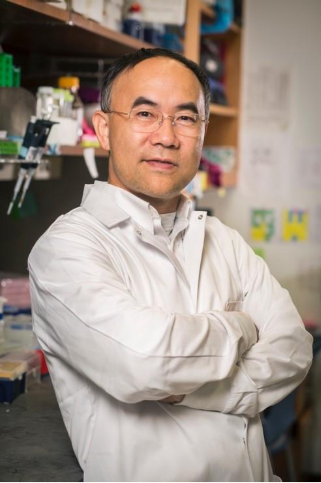
Above: Dr. Pei Zhou in the lab. Photo courtesy of Dr. Pei Zhou.
Reflecting on his career journey, Dr. Zhou says he wasn't always certain research was the right path for him. But by following his interests, he eventually arrived at Duke, where he now runs his own lab and mentors students. He shared a defining moment from the beginning of his scientific career: on his first day of graduate school, he saw another student holding a test tube filled with DNA. “I was just getting so excited,” he recalled. That moment of awe made science feel real and thrilling, an excitement he says he still feels every time he steps into the lab.
For students interested in scientific research, Dr. Zhou believes curiosity is the most important preparation. His advice is straightforward: Listen to your heart, listen to your mind, pursue what excites you. Genuine interest–not pressure or external expectations – is what he sees as the true driver of meaningful scientific progress.
Looking ahead, Dr. Zhou sees tremendous potential in structural biology. Rapid advances in artificial intelligence and protein-design technologies now allow scientists to predict structures, simulate interactions, and even build entirely new molecules with specialized functions. He believes these tools will accelerate drug discovery and help address increasingly complex medical challenges. At the same time, he acknowledges broader societal concerns, including growing mistrust in science. In response, he stresses the importance of clear communication and evidence-based reasoning to ensure that research continues to benefit society.
One of the aspects that Dr. Zhou finds most exciting about his work is the unpredictability of scientific discovery. His lab has encountered several unexpected results, such as a compound that triggered protein dimerization in an unanticipated way revealing a new mechanism with potential therapeutic value. In another project, the team identified an antibiotic inhibitor that adopted an alternative conformation. Recognizing this allowed them to modify the compound by changing just a single atom, dramatically increasing its potency. These moments, when the data surprise you and the answer appears right in front of your eyes, are what he says make research so compelling.
He recalled another memorable project in which a molecule under investigation as a possible cancer-therapeutic inhibitor bound to its receptor in a completely unforeseen way. After a year of work, the unexpected data illuminated the mechanism. Overwhelmed with excitement, he immediately texted his student, “We got it, we got it!” It is these moments – the discovery, the surprise, and the joy of finally understanding something new – that remind Dr. Zhou why he loves research.
Hannah Prince is a junior at the North Carolina School of Science and Mathematics. Hannah is interested in engineering, food science, and enjoys playing tennis and pickleball in her free time.
Loshini Talari is a junior at the North Carolina School of Science and Mathematics. Loshini is interested in biochemistry and enjoys swimming, reading, and exploring science through independent projects.