By Vivaan Grover and Lotus Qu
If you’re ever in the hallways of Duke Hospital, you might spot Dean Darnell in a whimsical cap and sneakers, coffee in hand. A professor of radiology, co-director of the MR Engineering Lab, and instructor of medical physics, Darnell fits into many of Duke’s academic corners. However, none of this happens without the ability to juggle a number of hats. Darnell constantly toggles between them – teacher and lab head, engineer and partner, committee member and advisor. His days could begin by deciding which cap to wear (sometimes literally), and end by editing a grant submission after fixing a puzzle for a student. When asked how he balances it, Darnell is straightforward: “I use a calendar, of course. “But sometimes, not everything can be done. I do me. I don’t really worry about tomorrow.”
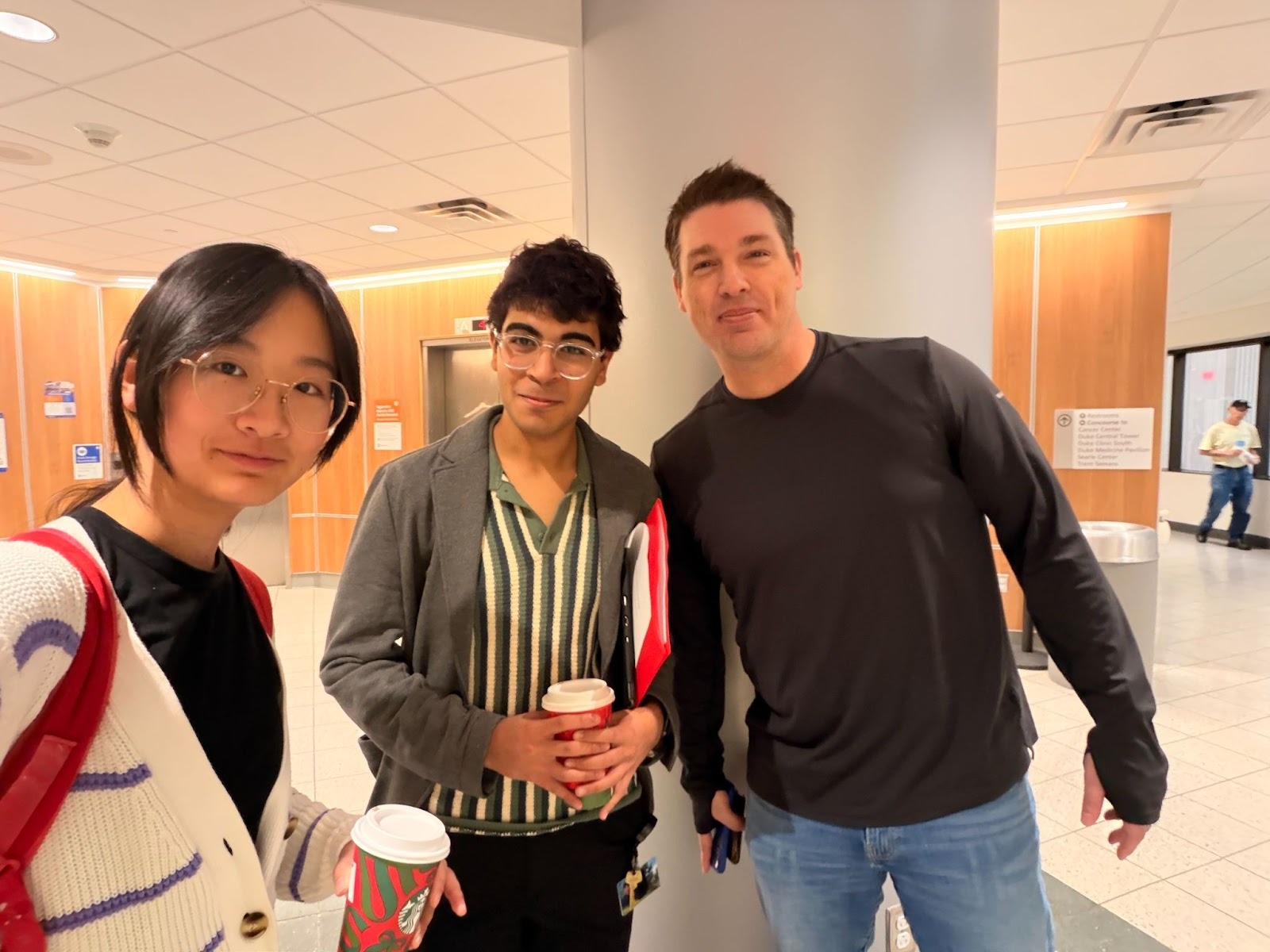
Above: Dr. Dean Darnell, Professor of Radiology and Co-Director of the MR Engineering Lab, poses for a selfie in Duke Hospital with Vivaan Grover and Lotus Qu.
Darnell has served as a postdoctoral researcher in a physics lab, worked in industry doing wireless technology engineering for Apple, subsequently received a Masters of Science, and is currently a professor for the radiology and Engineering departments of Duke University. On paper, it hardly sounds linear, but there is one common thread running throughout his career: impact. When Darnell designed technology at Apple, his work went into devices which were placed into millions of pockets. "We shipped more than 6 million phones," he remembers. "You really can touch a lot of people that way."
Impact is also what keeps Darnell at Duke. The MR Engineering Lab, which he co-directs, is a space tucked away in the vast Duke University Hospital. In the lab, graduate students sit together, drinking coffee and energy drinks, side by side with oscilloscopes, not yet realized code running on computer screens, and temperatures noted on computer models. Darnell is there, too, between the soldering iron and the telecon, partly boss, partly participant. “Honestly, the reason I stay is because of my students.” Darnell says. “There are a lot of bad engineers. If I can make a few better than me… that’s why I do it.”
Still, as an MRI engineer working to improve the machine, the ultimate goal is to see it put to use in the clinic. Darnell recalls being in the hospital with his PhD student, Olivia Jo Dickinson, and seeing a family with a neonatal baby who needed a scan. Getting an MRI as a baby is never pretty; the babies go inside the machine in an incubator-like box, sometimes nicknamed a “coffin,” covered in connections and wires. Children who require MRIs in the first place are not often there for minor procedures. They are almost always very sick, potentially even life-threatening illnesses. “The parents are terrified,” Darnell explains. “Mom and Dad can’t even get to their kid. So the idea was, how can we make this better for the entire family?”
Dickinson is currently working on a head coil for neonatal babies to wear inside the scanner that would lessen the time and effort required to set babies up in the scanner, making the process faster and easier, and freeing up valuable scanner time for other patients. “Eventually, we could have a wireless blanket to swaddle the neonate in. Once the coil itself is the blanket, we could swaddle the babies and once they’re asleep and ready to go, we can put them in the scanner,” Dickinson says. Since less motion is required to set up the babies, this would also allow the images themselves to be clearer.
For Darnell's lab, that’s the crux of being an engineer: identifying the problem and working to solve it. “I’m not too emotional,” Darnell says. “But I’ve been given a set of talents, and I use them the best I can.” Darnell recognizes what his work as an engineer could mean to others. He believes worth is not found on the business card on his door but the solutions he and his team create. "Don't call me Doctor. My name is Dean.”
To Darnell, engineering is a team sport. His brainstorming process involves throwing arguments back and forth. If his students screw up – and, of course, they always will when it involves experimentation – it is his practice to tell them to look at failure as data. The implication is unequivocal: His students are free to fail. In an industry plagued by flawed technology, teaching is perhaps his most potent act.
Darnell’s work has an impact. Every redesign of a scanner, every patient-focused design, every brainstorming session with a student is an act of caring. And perhaps the most "engineer-like" thing about empathy is not speeches nor gestures, but the doing, quietly, of what needs to be done to make the world ever so slightly more gentle than it otherwise might have been.
Lotus is a junior at the North Carolina School of Science and Math and is interested in neuroscience, Cantonese films, and science communication. She loves to write reviews, paint, and fold more fish.
Vivaan is a junior attending the North Carolina School of Science and Mathematics in Durham, NC. He is focused on science, innovation, and leadership, with experience in medical research, public speaking, and inspiring people. He spends his free time enjoying science communication, making music, and playing tennis.