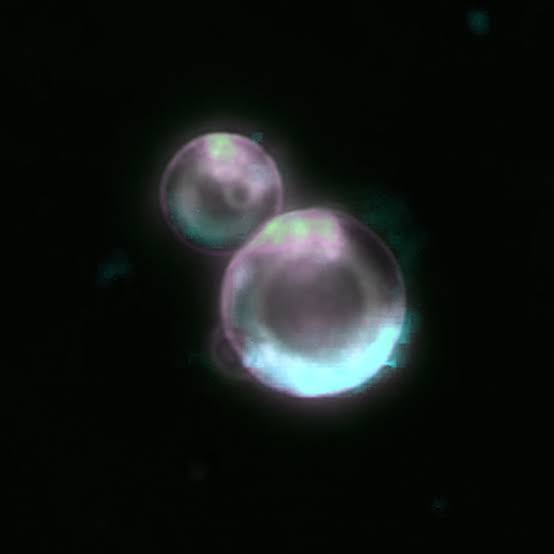
Above: Spud Cell image taken via microscopy. Image courtesy of Adamala Lab.
Image Source: https://www.science.org/content/article/lab-created-spudcell-marks-major-step-toward-building-life-scratch
Scientists at the University of Minnesota have created the first synthetic cell capable of completing a life cycle—a major scientific breakthrough that could revolutionize the field of molecular biology. The name, Spud Cells, is meant to echo the first satellite, Sputnik, another landmark achievement that expanded the scientific frontier. Researchers joked that the name was originally picked because the cells resembled a round potato.
The size of a pinprick and only visible under a fluorescent microscope, a Spud cell appears as a droplet surrounded by a fatty membrane. Inside, it can hold molecules and snippets of DNA encoding 36 genes with about 90 base pairs. Unlike previous artificial cells, which are built from existing cell lines stripped down to their essential parts, Spud cells are built from the bottom up using chemical building blocks. This approach allows scientists to test individual factors in cells through gene editing. For example, Adamala and her fellow researchers were able to insert a genetic mutation in some Spud Cells, causing them to produce more surface tags. The additional tags increased the cell’s nutrient uptake and, in turn, promoted cell growth. By modifying the cells to absorb nutrients more efficiently, scientists can potentially improve their growth, productivity, and usefulness for the creation of medicines and therapeutic proteins.
Spudding Skepticism
However, these little "potato-like" cells have already stirred controversy. Kate Adamala, an Associate Professor of Genetics at the University of Minnesota, says their 190-page manuscript was rejected by a prestigious scientific journal, Cell, after one reviewer argued that Spud Cells were not “real biology”. In response, Adamala contacted the press while the manuscript was still under embargo to promote their research, a highly unconventional move in academic publishing.
The cells still have significant limitations to overcome before they can be used in more complex research projects. For one, they can only replicate under stress or when manually pressed through a membrane. Furthermore, by the fifth round of replication, only 30% of Spud Cells retained the full genome: a significant limitation for any genetic researcher. The cells may also face challenges in maintaining the stability of organic materials, such as ribosomes, which degrade over time and cannot be replaced.
Despite these limitations, Spud Cells represent a significant advance in biological engineering. Now that scientists can create small, artificial cells from scratch, there is potential to design cells for new bioengineering applications. These cells could perform molecular transformations that industrial chemistry cannot, opening new doors for personalized medicines produced through natural cellular processes. These cell systems could also make these processes more streamlined for industrial applications. The possibilities are endless for this small cell.