A Journey Through the Heart: Dr. Gabby Esmailian’s Path to Becoming a Heart Surgeon
By Katherine Sproul and Rishika Subudhi
For some clinicians, a career in medicine starts with a single moment of inspiration. For Dr. Gabby Esmailian, it began at the heart of the organ transplant process itself. Esmailian, currently a researcher at Duke University, is completing part of his surgical residency through a dedicated research program. Esmailian's path to medicine began during his undergraduate studies at UCLA. Esmailian got a job as a heart and lung procurement technician at Cedars-Sinai Medical Center. In this role, he helped procure the organs needed for transplant with the transplant surgeon. This not only involved facilitating communication between the recipient and donor operating rooms but also maintaining and ensuring that the right instruments and materials were available to preserve the organ. Esmailian was right in the middle of that process, and it was through this experience that he became interested in organ transplantation, especially procedures involving the heart. Esmailian’s experiences led him to medical school at George Washington University in 2019.
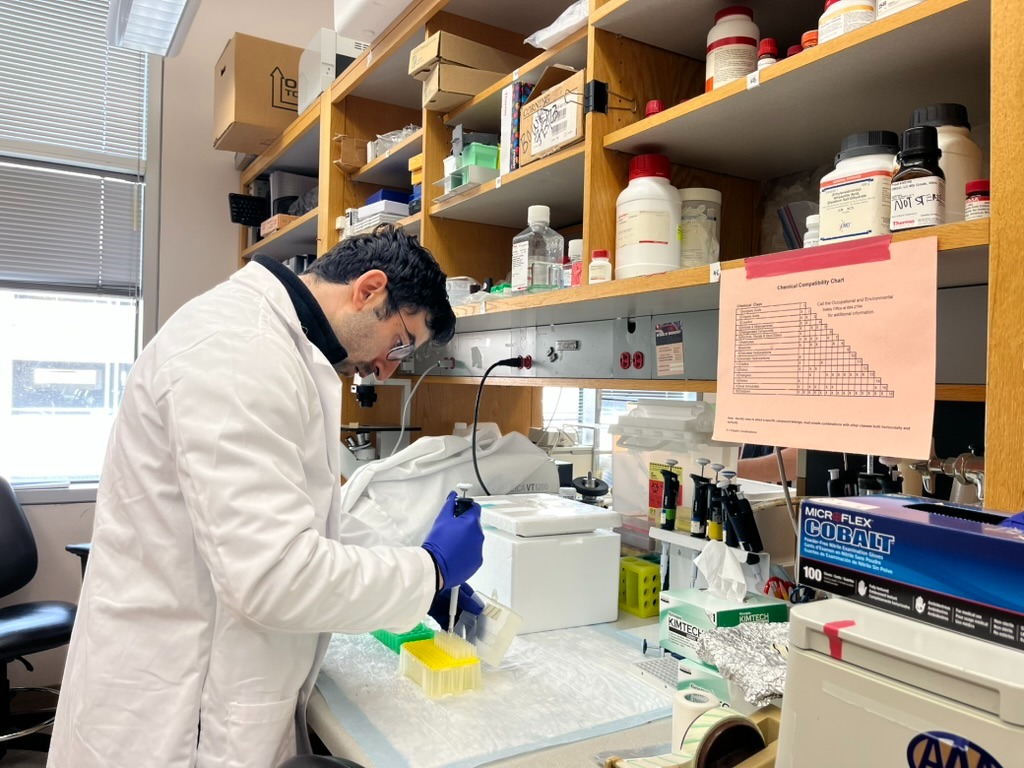
Above: Dr. Gabby Esmailian conducts an experiment at the bench. Photo courtesy of Katherine Sproul.
During his training, Esmailian conducted research on the impacts of the COVID-19 pandemic on heart transplant surgery and discovered a harsh reality: after heart transplants, patients are given immunosuppressants to ensure that their bodies do not fight the foreign organs. As you can guess, suppressing the immune response, the thing that prevents most people from getting sick, leaves patients vulnerable to infections and disease.
Motivated by his interest in the intersection of immune responses and organ transplantation, Esmailian began two years of general surgery residency at Indiana University in July 2023, where his program then allowed him to conduct research at Duke University through June 2027. At Duke, he works with teams that study heart tissue, organ transplantation, and transplant outcomes, while also helping manage a large heart tissue repository used by researchers around the world. Esmailian’s role includes attending weekly meetings, assisting in experimental surgeries, and reviewing data. This provides him with experience in both clinical care and basic scientific research.
As such, Dr. Esmailian’s current project focuses on one of the biggest challenges in organ transplantation: preventing the body from rejecting a donor organ. His research aims to reduce the need for immunosuppressants by using gene therapy directly on the donor heart before transplantation.
To make this possible, the team uses a device called the Organ Care System, which keeps a donor heart warm and beating outside the body so it can be treated with blood and nutrients. A specially designed viral vector is then circulated through the heart while on the device. This virus carries a gene that, when overexpressed, may help prevent rejection and is able to enter only the donor heart, not the rest of the body. Because the treatment stays isolated to one organ, it reduces the risk of potential side effects. Early tests in mice have shown that the treated hearts survive longer and exhibit fewer signs of rejection. The team has now begun moving into larger models like pigs, which is an important step toward eventually testing the method in humans. If successful, this method could one day help transplant patients avoid lifelong immunosuppressant medication and reduce their risk of future infections and cancer after transplant.
When asked what he would say to his younger self, Dr. Esmailian said: “Everything happens for a reason.” For most people, that is hard to believe. And for many, the “perfectionists,” as Esmailian said, this notion feels almost impossible. His own path to medicine wasn’t straightforward; Esmailian went through a rigorous medical school training and completed two years of general surgery, both of which required him to move to various parts of the country. During a month-long rotation at Duke as a medical student, he realized he had to trust his instincts and do what was best for him, even if it meant travelling to a new place. This decision ended up guiding him to the right place, and his story is a reminder that sometimes you just have to trust yourself and keep going.
Rishika Subudhi is a junior at the North Carolina School of Science and Mathematics. Rishika is interested in physics and biology and enjoys dancing and reading.
Katherine Sproul is a junior at the North Carolina School of Science and Mathematics. Kate is interested in human biology and enjoys playing basketball and soccer.