By London Jackson and Jayla Sumpter
Dr. Sarah Gaither, principal investigator of Duke’s Identity and Diversity lab, reminds us that our identities aren’t fixed labels, but rather living proof of who we are and how our experiences shape us. Everyone interacts in different contexts, whether that be with a boss, a friend, or a grandparent. Gaither and her team explore how multiple identities, including racial and cultural ones, can change over time or between contexts and interactions. The Gaither Lab has contributed to a better understanding of mixed identities, demonstrating that identity isn't just something we carry; it's something we perform, negotiate, and sometimes even protect depending on the moment. Identities fluctuate over one’s lifespan, and denying one’s identity can have physical health consequences.
Gaither describes herself as a “Me-searcher,” someone who seeks to understand their own experiences through the data and experimentation inherent to the scientific process. As a biracial and white-passing scientist with a white mother and a black father, Gaither grew up questioning how different identities coexist and interact, and how the visibility and invisibility of identities influence a person.
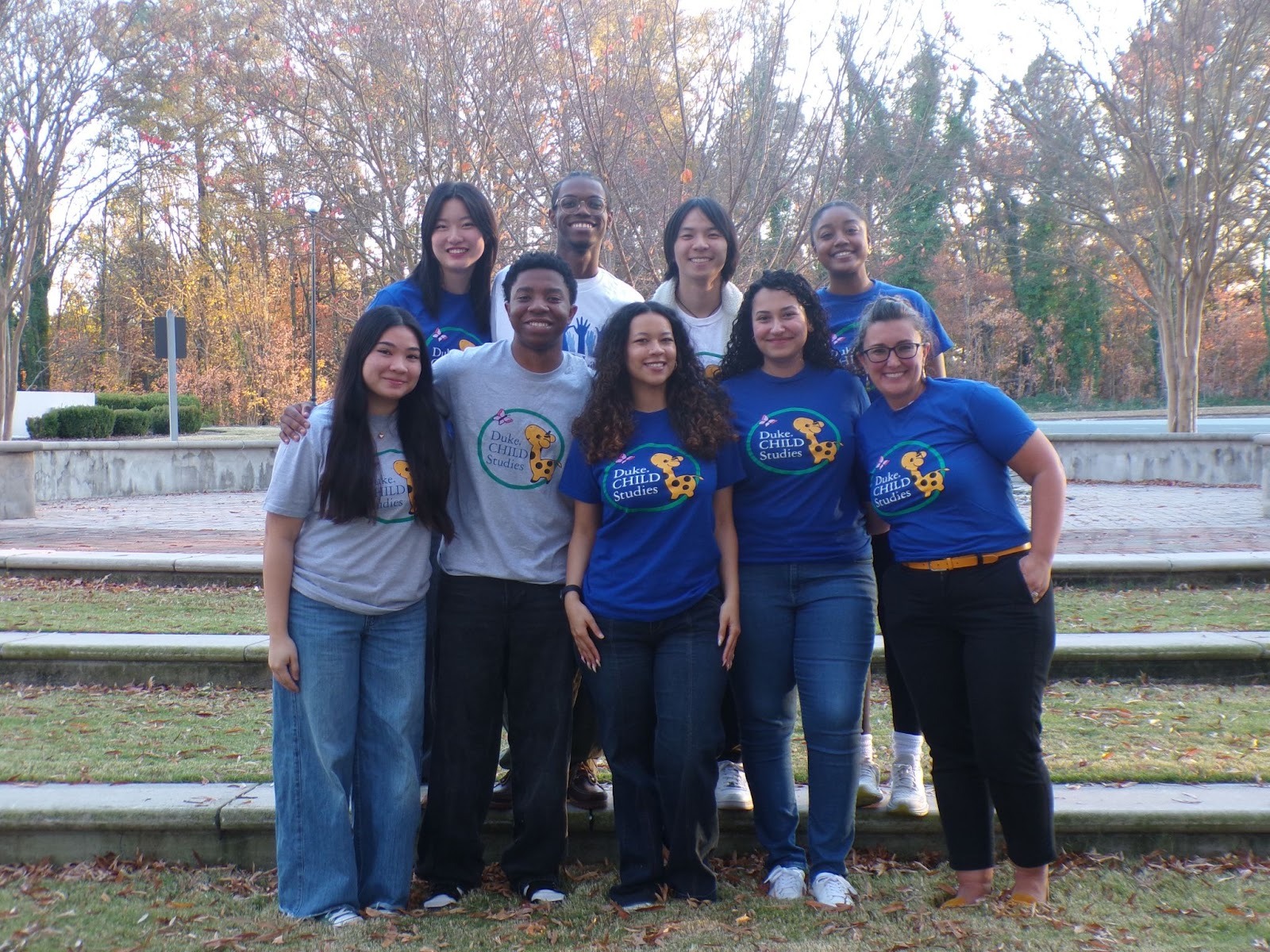
Above: Dr. Sarah Gaither (bottom right) and her research group. Photo courtesy of Hannah Garner.
This curiosity pushed Gaither to consider a PhD in developmental or social psychology, and she ultimately completed her doctorate in the latter so that her research would apply to people of a variety of ages. Her curiosity stems from seeking to understand her own experience and the experiences of others. Her “me-search” doesn't just answer her own questions, but also opens the door for countless others whose experiences have been long overlooked or mislabeled.
Growing up in California and attending UC Berkeley for her undergraduate studies, Gaither spent her formative years in a liberal environment. However, she vividly remembers meeting her conservative college roommate, who proudly displayed a framed family photo including George Bush and a giant Texas flag. Living with someone with a different background and political views taught Gaither how to think and communicate across ideological lines. “Just because you have different backgrounds or different lived experiences doesn’t mean you can’t find common ground or common identities,” she explained.
Living in a dorm room with this kind of ideological diversity shaped how Gaither approaches facilitating communication across different groups and understanding their experiences. Listening to different perspectives would lead a “me-searcher” to ask: How could we measure this empirically? Empirical research and measurable data are critical for understanding others. Gaither knows that data is what pushes society to pay attention. Without measurable evidence, even the most common human experiences can be ignored. Gaither stated, “Until you have data behind something… people won’t necessarily believe that it’s true.”
Cultural perception of how much an identity matters dictates how much it matters. For example, children become aware of their gender by about three years old. When they start school, their gender is relevant to their daily life because it determines which bathroom they use. Their gender also determines which toys, clothes, and colors are marketed to them through peers and media. Awareness of race or ethnicity comes in later, around ages five or six, since that aspect of identity is less binary and treated differently within our society.
Experiments on interracial interactions can yield different results depending on the cultural era in which they were conducted. For example, studies on interracial interactions could indicate higher animosity if conducted during a less equal era. In this line of research, it’s especially important to stay current on what different labels and identities mean to people.
Visibility for all is essential for improving people’s lives. In 2000, the U.S. census first allowed people to check more than one racial identity, finally allowing census data on multiracial people to be accurately reported. These kinds of changes are important because they decide what groups are allowed to have data and documentation behind them.
Dr. Gaither’s work tells us that identity isn’t a static fact. It's a relationship between who we are and how the world sees us. Understanding that relationship, with empathy and evidence, is what allows us to build a society where more people can be seen as their full, complex selves.
London Jackson is a junior at the North Carolina School of Science and Mathematics. London is interested in chemistry, writing, and enjoys painting.
Jayla Sumpter is a junior at the North Carolina School of Science and Mathematics. Jayla is interested in law and enjoys reading.