Collaborative Paths in the Study of Brain Cancer and the Immune System
By Lydia Le and Zephyn Manning
Sitting on the same floor of Duke’s Medical Sciences Research Building, two scientists are attacking brain cancer from opposite angles. Just doors apart, Dr. Kathy Ayasoufi and Dr. Michael Brown spend their days unraveling the complex relationship between tumors and the immune system.
Dr. Ayasoufi studies the body as an interconnected network, investigating how brain tumors influence immune system responses throughout the rest of the body. Just down the hallway, Dr. Brown takes a more targeted approach, harnessing viral therapies to train the immune system to recognize and attack cancer cells. Though their methods differ, they’re united in their passion for their work and their commitment to understanding and fighting one of modern medicine’s most complex challenges.
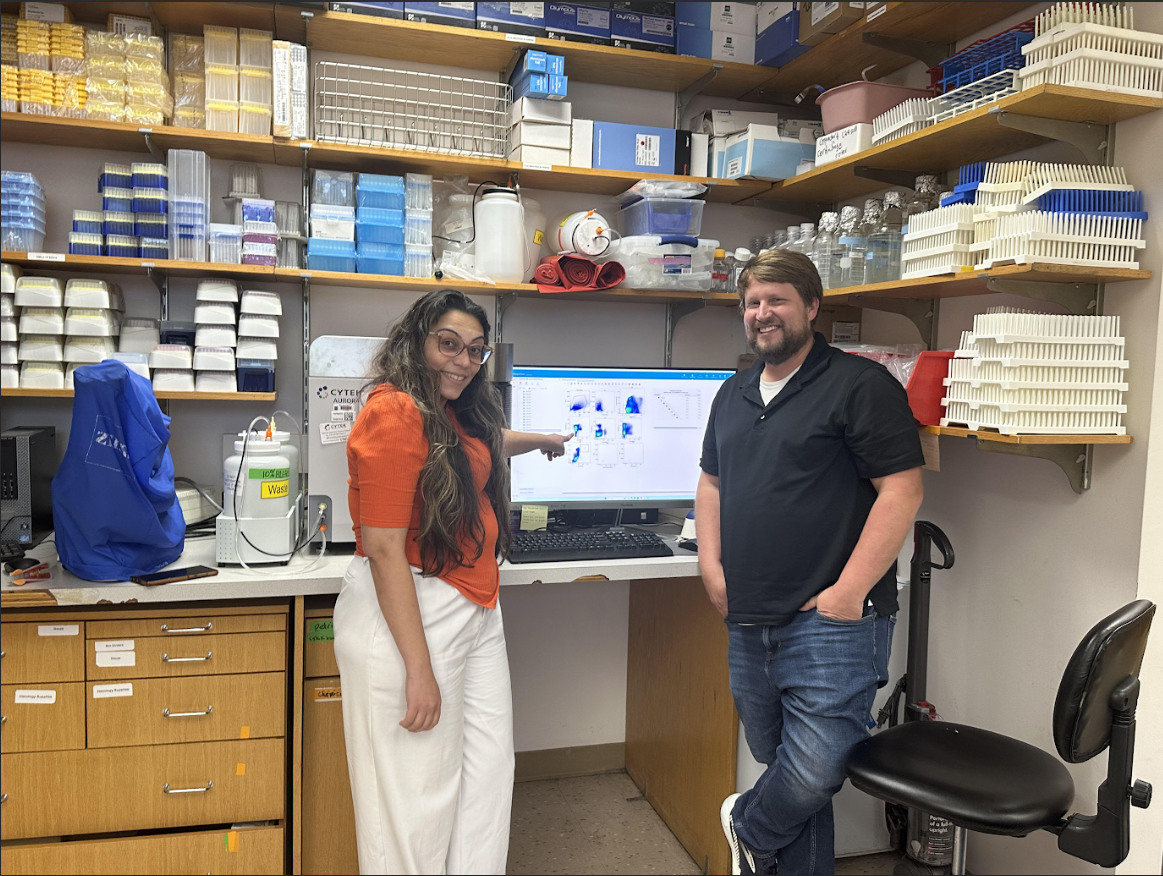
Above: Drs. Kathy Ayasoufi (left) and Michael Brown (right) stand in front of a flow cytometer in the lab. Photo courtesy of Lydia Le.
While they work together closely today, their journeys before and on this shared floor began in remarkably different places. Dr. Ayasoufi’s path started in Iran, where she was raised and attended high school before moving to the United States. She enrolled in community college once she arrived, learning English as her second language, then went on to a 4-year college when she was 17. When told that her immigration and dedication to learning at such a young age were impressive, she dismissed the praise. “I don’t know, impressive is not the right word. Sometimes it’s just a necessity,” she said. Ayasoufi expanded upon her reasons for immigrating: “It’s a difficult political environment there [in Iran]. You grow up being told that as a woman, you have no place in the places you want to be.” After earning her PhD in Cleveland and completing her post-doctoral training at Mayo Clinic in Minnesota, Ayasoufi accepted a faculty position at Duke University, where she now runs her own lab funded through a National Institute of Neurological Disorders and Stroke (NINDS) grant.
By contrast, Dr. Brown is a North Carolina native. He completed his undergraduate studies at the University of North Carolina at Chapel Hill, initially planning to become a medical doctor. However, he explains, “Towards the end of college I realized I really love the nitty-gritty details.” Brown took a bacterial pathogenesis class that made him realize he enjoyed diving deep into scientific literature and learning about how bacteria worked. His experience informed his decision to pursue a PhD in microbiology at Duke. Though he intended to study bacteriology, he found himself pulled towards an involvement in a virology lab, where he studied the use of viruses as a treatment for cancer. He became attached to the project and decided to stay at Duke as a faculty member to continue pursuing similar research.
Beyond the life-saving impact of their work, both scientists also share a love for the thrill of the research process. “A lot of people think we do what we do just to, you know, cure a big disease,” Brown explains. “And that is a big part of it, but the part that I think most scientists enjoy is piecing together puzzle pieces – understanding how things work.” Scientists are master puzzle-solvers, able to piece together even the most complex quandaries simply because the mystery itself is worth exploring.
While some might enjoy the idea of pursuing their own individual puzzles, they emphasize that collaboration is key for any kind of scientific research. As Dr. Brown puts it, “That’s how it works in science. You really need collaboration if you really wanna make a difference.” Dr. Ayasoufi added, “A lot of times when you get into the nitty-gritty of your own research, you get tunnel vision…How I get out of that is I go and talk to my other coworkers, like Mike.” Cooperation among researchers can be the key to unlocking any scientific discovery.
When asked for some final advice for anyone interested in research, this dynamic duo gave some unique guidance. “Pick the mentor rather than the project,” says Dr. Ayasoufi. She continues, “A lot of people think they just want to do this one project, but they can be excited about a lot of different projects in the right environment, while learning about the scientific method and how to ask questions.” Dr. Brown adds a simple but crucial directive: “If you do get an opportunity like that, work hard.” Inspiring STEM students today, Dr. Ayasoufi and Dr. Brown push the boundaries of immunology research every day, drawing on their diverse backgrounds to fuel their shared passion as collaborators in Duke University’s laboratories.
Lydia Le is a senior at the North Carolina School of Science and Mathematics. Lydia is interested in oncology, constructing circuits, and enjoys reading science fiction novels.
Zephyn Manning is a junior at the North Carolina School of Science and Mathematics. Zephyn is interested in philosophy, molecular biology, and enjoys playing guitar.