By Nishka Goggi and Abigail Keaton
One word captures the essence of Dr. Leah Acker: passionate. A neuroscientist and anesthesiologist at Duke University, she greets lab members and visitors with a warm smile, charming office, and bright, curious excitement in her eyes. While her role as a principal investigator involves designing experiments, revising papers, and writing grants, Dr. Acker is also a practicing neurosurgical anesthesiologist. She meets with patients frequently, ensuring her main priority of helping real patients and changing lives never drifts too far from her research. She doesn’t view patients as data points in an experiment, but rather as people with complex backgrounds and life experiences that can affect how they contend with medical challenges.
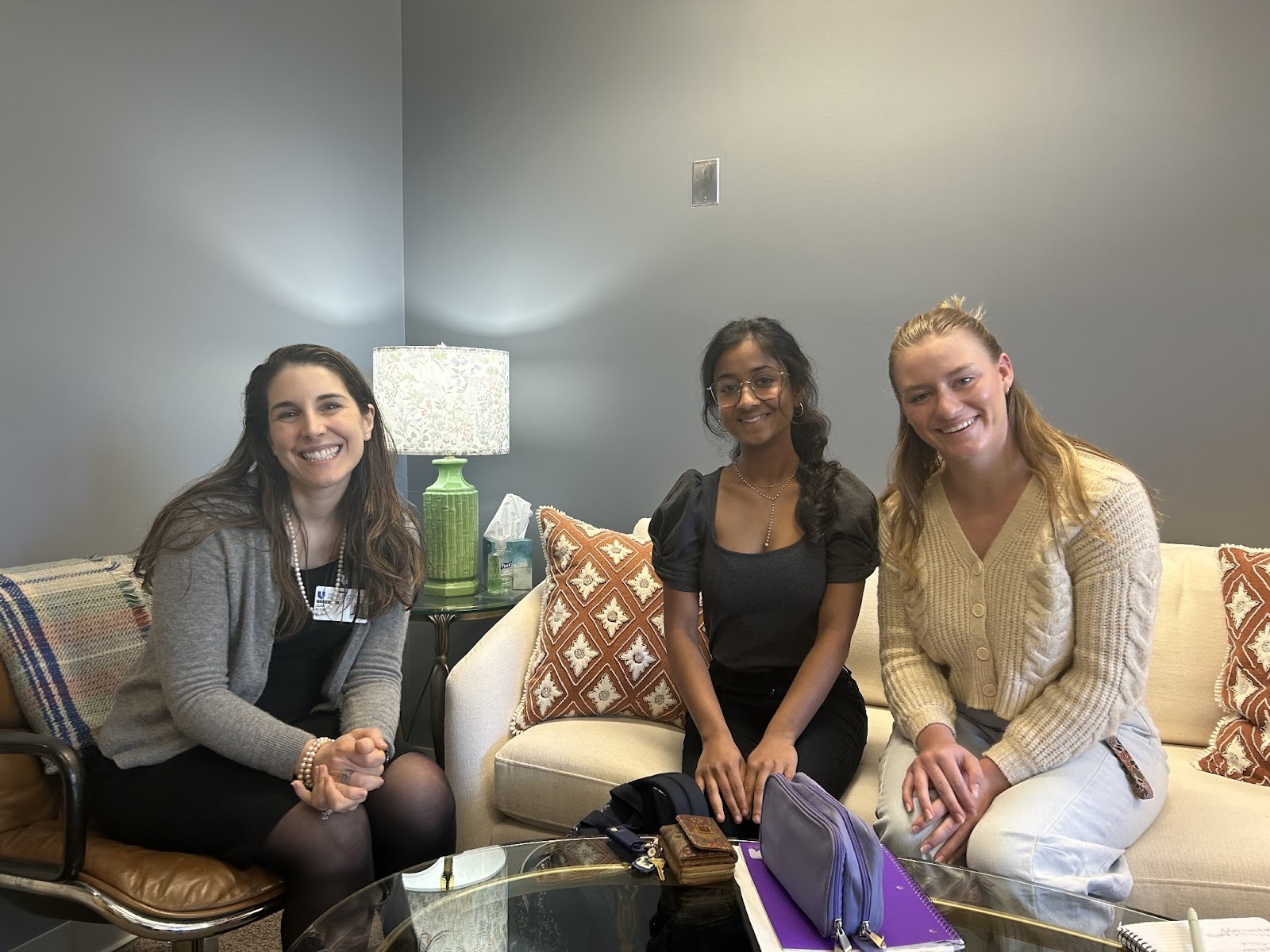
Above: Dr. Leah Acker (left) poses for a photo in her office with Nishka Goggi (center) and Abigail Keaton (right). Photo courtesy of Hector Sanchez Melendez.
This patient-centered perspective was shaped by her grandmother, an 85-year-old woman who fiercely valued her independence. When diagnosed with a minor cancer, she surprised Acker by hesitating to undergo curative surgery. She feared that the operation would risk her brain health and force her to sacrifice some of her autonomy – a fate she found scarier than the cancer itself. “It was just really kind of eye-opening to me that this is a place where maybe we are doing harm inadvertently at times or not helping people the way that we think,” Acker explained. “And it's something that I think we need to do better.” Although the surgery was the seemingly obvious medical solution, protecting the patient’s independence and autonomy was equally as vital. Safeguarding brain health throughout surgery became a priority, and that is where the ACkER lab comes in.
The ACkER lab, led by Dr. Acker, is made up of a diverse team bridging clinical research, neuroscience, and engineering with the goal of helping patients who’ve been under anesthesia recover better and faster after surgery. By studying how the heart, brain, and immune system cooperate and working with patients to better understand their experiences, Dr. Acker and her lab aims to design non-invasive technologies that can eventually replace the use of drugs in anesthesia.
Dr. Acker’s path to creating her own lab was paved by persistence and the journey wasn’t easy. After earning her PhD, she went further, gaining more medical knowledge through an MD to use in tandem with her passion for engineering. Many of Acker’s previous projects have been met with success; in fact, one of them won MIT’s prize for best PhD thesis in brain research, getting published in various scientific journals and magazines. “It was just incredible, but it was actually my tenth project, so I had nine other projects that I tried that all failed for various reasons,” she explained. Ackeer credits these past failures for her current understanding of why projects succeed or fail.
For the next generation of aspiring scientists, Dr. Acker offers clear advice: “You need to be pushing the boundaries on things scientifically and really stretching yourself because any stretch you do now just puts you further ahead for the next stage.” She consistently encourages her own team to push the envelope with their research and actively shoot for the moon, noting that a no-risk mindset leads to no reward.
Her dedication extends beyond the office, where Acker is involved in a myriad of hobbies and interests. As an avid home renovator, she loves DIY-ing projects in her free time, from creating a four-season porch to building a backyard swing. She also works to blend her home and work life as a mother of four children—ranging in age from nine months to eight years—often bringing them to the lab in tiny lab coats to teach them the principles of science.
Despite her successes, Dr. Acker isn’t done learning. She’s currently studying attention, control, and perception as part of her specialty in anesthesiology. She believes exploring these specific components of consciousness is the key to gaining better insight into how unconsciousness can be safely induced before surgery. Ultimately, Dr. Acker and her lab are working to construct a future where every surgery patient can make a full cognitive recovery.
Nishka Goggi is a junior at the North Carolina School of Science and Mathematics. Nishka is interested in clinical biology, classical dance, and enjoys being outside.
Abigail Keaton is a senior at the North Carolina School of Science and Mathematics. Abigail is interested in neuropsychology, weightlifting, and enjoys creative scrapbooking.