One Mother, Two Species: Ant Queens Clone Other Species to Increase Colony Productivity
Most living species produce offspring of the same species: cows give birth to calves and chickens lay eggs that hatch into chicks. However, scientists have recently discovered that the reproductive biology of a unique ant species is more complex. The researchers uncovered an evolutionary anomaly: the M. ibericus ant queen is xenoparous, meaning she gives birth to multiple species as an important part of her lifecycle.
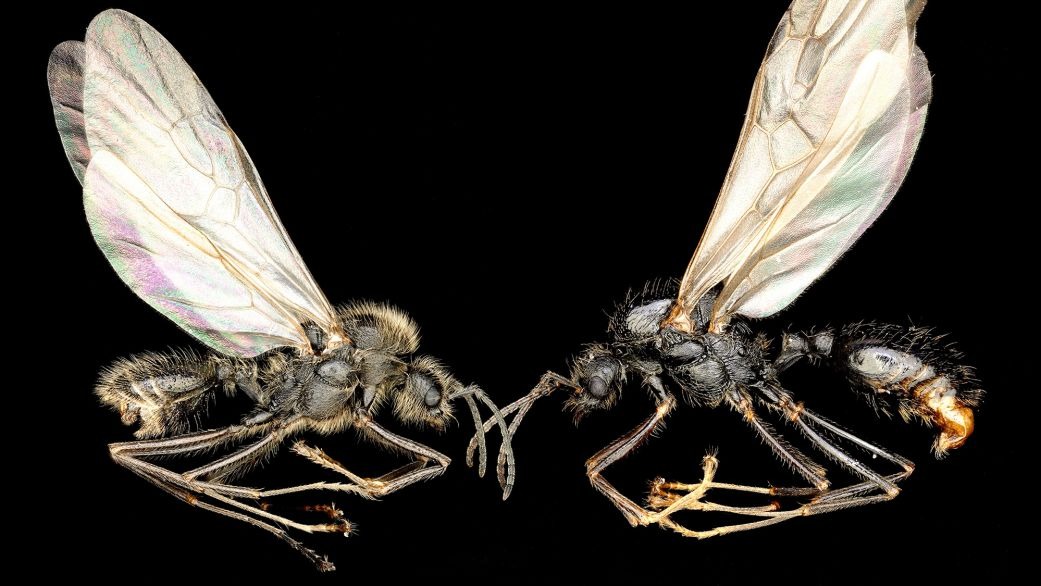
Above: M. ibericus ant queens produce two different species: M. structor males (left) and M. ibericus males (right). Image courtesy of CNN.
To the average onlooker, ants can often seem like the most insignificant insects. Other than interrupting your picnic or infesting your kitchen, ants often mind their own business, drawing little attention from humans and paying us little attention in return. However, in reality, these small creatures are really complex insects with unique mating systems.
The Biological Basis of Cloning
Ant colonies rely on their queen, but also on the work of laborers. Typically, each ant colony includes a queen who controls fertilization and the production of a caste system: sterile females who are the primary workers, and males who leave the colony to mate with other queens. However, in select species like M. ibericus, the sperm of the M. ibericus males can only produce queens but not sterile workers. So how do M. ibericus queens form their working class? The answer lies in M. structor sperm. The M. ibericus ant queens, a species found in areas with low-elevation, can clone male M. structor ants, a mountain-dwelling species. This allows the queen to give birth to new, working class ants without transmitting any of her own nuclear DNA. But if these species live thousands of kilometers apart, how does cloning another species work biologically?
Ants reproduce in very unique ways. The queen ant mates once and then stores the sperm in an organ called the spermatheca to control egg fertilization for the rest of her life. This type of sperm parasitism allows the two species M. ibericus and M. structor to live in distant locations while still reproducing with the other species.
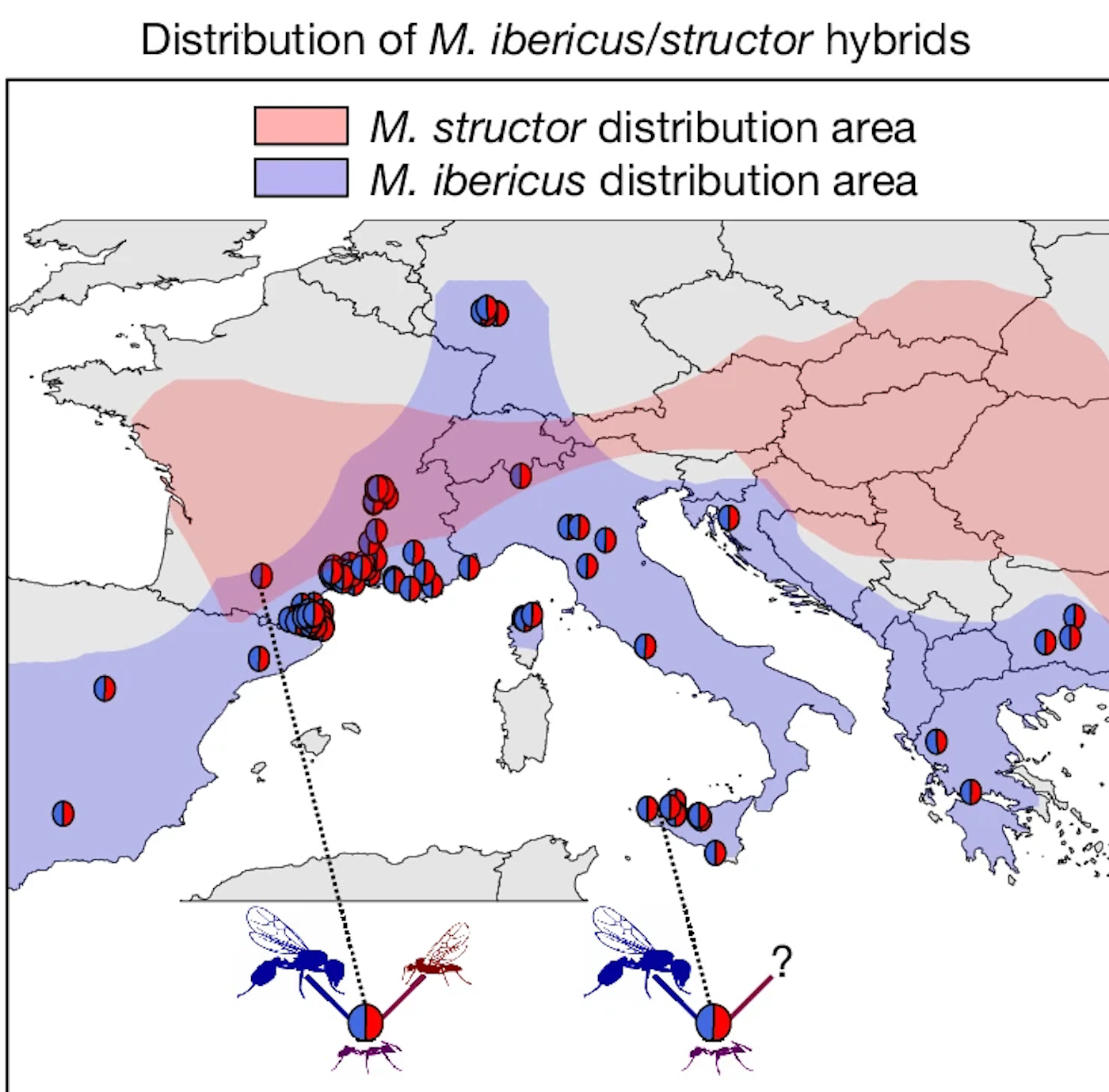
Above: Distance between populations of M. structor and M. ibericus. Courtesy of Juvé, Y., Lutrat, C., Ha, A. et al.
Evolutionary Advantages
Scientists believe that evolutionary reasons drive this need for an additional ant species to support the colony. The M. ibericus queens can reproduce with their own species to make new queens, but not sterile workers. The queens clone M. structor ants to create their working class, diversifying and increasing their caste system to benefit the colony. Additionally, this benefits M. structor ant colonies as it allows for the spread of their DNA,propagating their genome across other species. These species have a symbiotic relationship: M. ibericus ants rely on M. structor to form their worker caste, while M. structor ants rely on M. ibericus to act like surrogates to reproduce their species.
The relationship between these two ant species mimics endosymbiotic theory. According to this theory, a prokaryotic cell engulfed a bacterial cell, giving rise to the first eukaryote that had both mitochondrial DNA and nuclear DNA. The M. structor male ants have their own nuclear genomes but the mitochondrial genome of M. ibericus ants. The complex social structure and mating systems in ants and other insects defies our current knowledge of reproduction. Continuing to study these ant species may expand our knowledge of evolution in nature and the complexity of biological organisms.